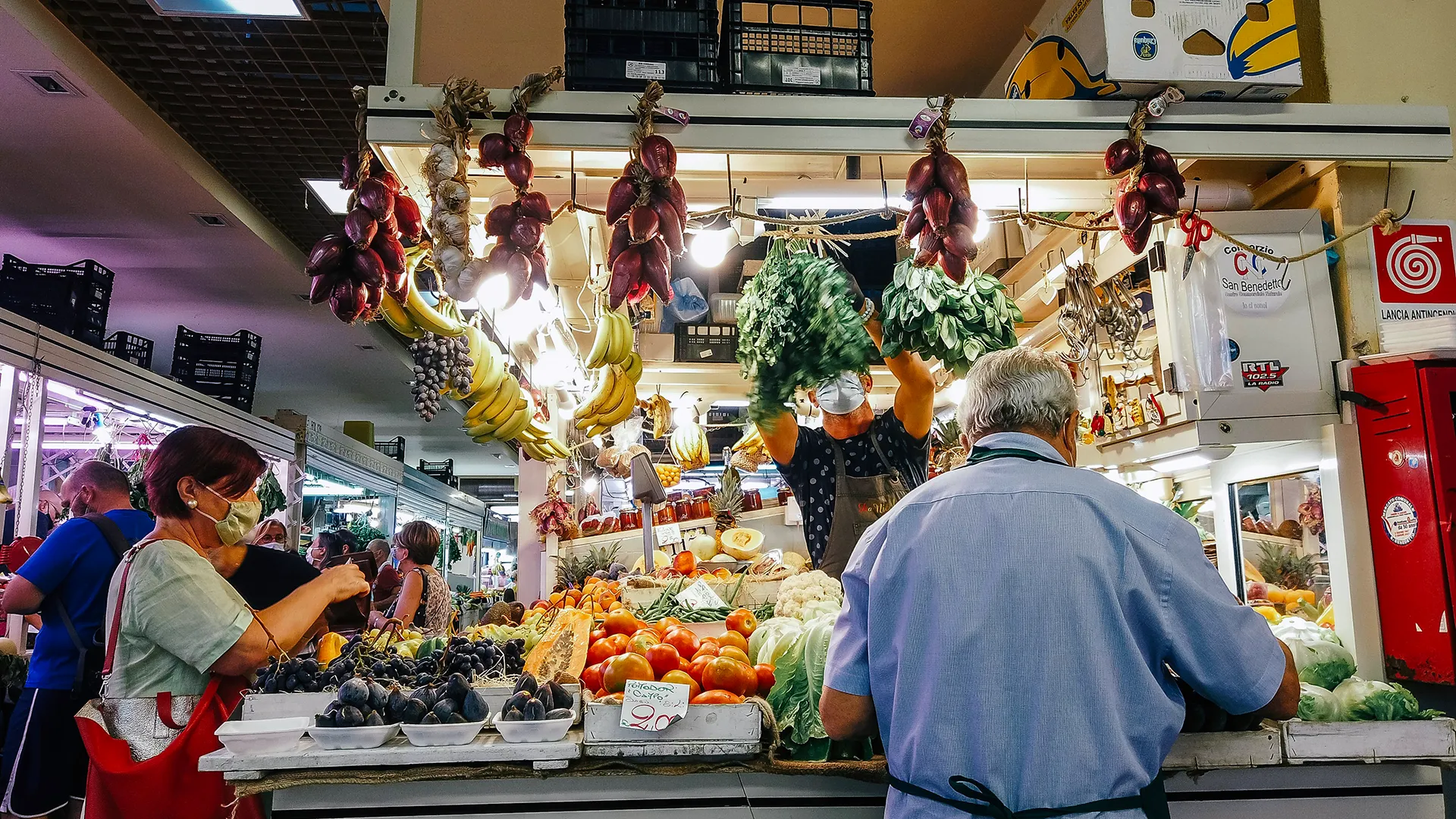
San Benedetto Market tells the story of Cagliari through work, food and everyday relationships. Fish, vegetables, meat and cheese connect shopping with the places that supply the city and the people who bring their products to its stalls.
Its history is part of the story of Cagliari’s civic markets: from the nineteenth-century buildings in Largo Carlo Felice to the premises opened in 1957, and the temporary move to Piazza Nazzari during renovation work. Different locations have served the same role as places of trade and city life.
Before San Benedetto: the old market
Before San Benedetto was built, Largo Carlo Felice was home to one of the city’s main markets. Designed by Enrico Melis and opened in 1886, the complex consisted of two buildings separated by a passage corresponding to today’s Via Mercato Vecchio.
Photographs and postcards held by Cagliari’s University Library show its iron, cast-iron and glass structures. These documents help visitors picture a place that has disappeared and connect the streets of today with the spaces where people once did their shopping.
A market in a traveller’s account
In 1921, David Herbert Lawrence visited Cagliari while travelling with his wife Frieda. The old market became part of his account in Sea and Sardinia, with its attention to the goods on display and the people involved in trade.
The memory of a market therefore extends beyond its buildings. Postcards, photographs and written accounts preserve habits and gestures that changes to the city can make harder to see. The Ministry of Culture’s virtual exhibition about the old market explores this relationship between images and storytelling.
The new market of 1957
According to the official municipal record, the premises in Via Francesco Cocco Ortu opened on 1 June 1957. Its two levels, each covering around four thousand square metres, gave the market a different scale from its nineteenth-century predecessor.
The arrangement brought different food departments and businesses together. San Benedetto came to identify both a place for shopping and a recognisable part of the city, familiar to the people who bought and worked there.
The stalls and knowledge of food
A food market can also be understood through the small decisions made while shopping: recognising a fish, asking how to prepare it, comparing vegetables or cuts of meat. These ordinary gestures connect food with the work of the seller and the cooking of the buyer.
Fishmongers, butchers, fruit and vegetable stalls, bread, cheese and other food shops form the range described by the municipal tourism portal. For visitors, this variety offers a way to approach local food culture through a place used in everyday life.
From the historic building to Piazza Nazzari
The historic building closed for renovation in March 2025. Businesses moved to the temporary structure in Piazza Nazzari, identified by the municipality and Cagliari Turismo as the market’s location during the works.
A municipal announcement dated 17 February 2025 preceded the move, giving 1 March as the final trading day in the Via Cocco Ortu building. This stage in the market’s history shows how much its role depends on continuity of work and contact with customers.
It is useful to distinguish the historic building from the temporary premises. The name San Benedetto continues to identify the community of traders, while visitors should check the current address through official channels before setting out.
Five things to remember
- A street preserves the name: Via Mercato Vecchio recalls the earlier complex in Largo Carlo Felice.
- A market described by Lawrence: he visited the nineteenth-century market in 1921, before San Benedetto existed.
- A precise opening date: the municipality records 1 June 1957 for the historic San Benedetto premises.
- Two levels for shopping: the Via Cocco Ortu building occupies two large floors.
- Trading continues during renovation: official pages identify Piazza Nazzari as the temporary market.
Visiting San Benedetto today
Cagliari Turismo lists access to the temporary structure from Via Sant’Alenixedda, Via Bacaredda and Via Cao di San Marco. Check the municipal website for the current address, opening hours and updates about the move before visiting.
A visit calls for consideration of the place and its people: leave room for shoppers, ask before photographing stalls and follow traders’ guidance. These small gestures help visitors discover San Benedetto through its daily work, beyond images of the historic market.
Sources consulted
- Municipality of Cagliari: San Benedetto civic market (Italian)
- Cagliari Turismo: San Benedetto Market, Piazza Nazzari (Italian)
- Municipality of Cagliari: renovation announcement, 17 February 2025 (Italian)
- Ministry of Culture: the old market in historical postcards (Italian)
- Cagliari University Library: historical photographs of the old market (Italian)