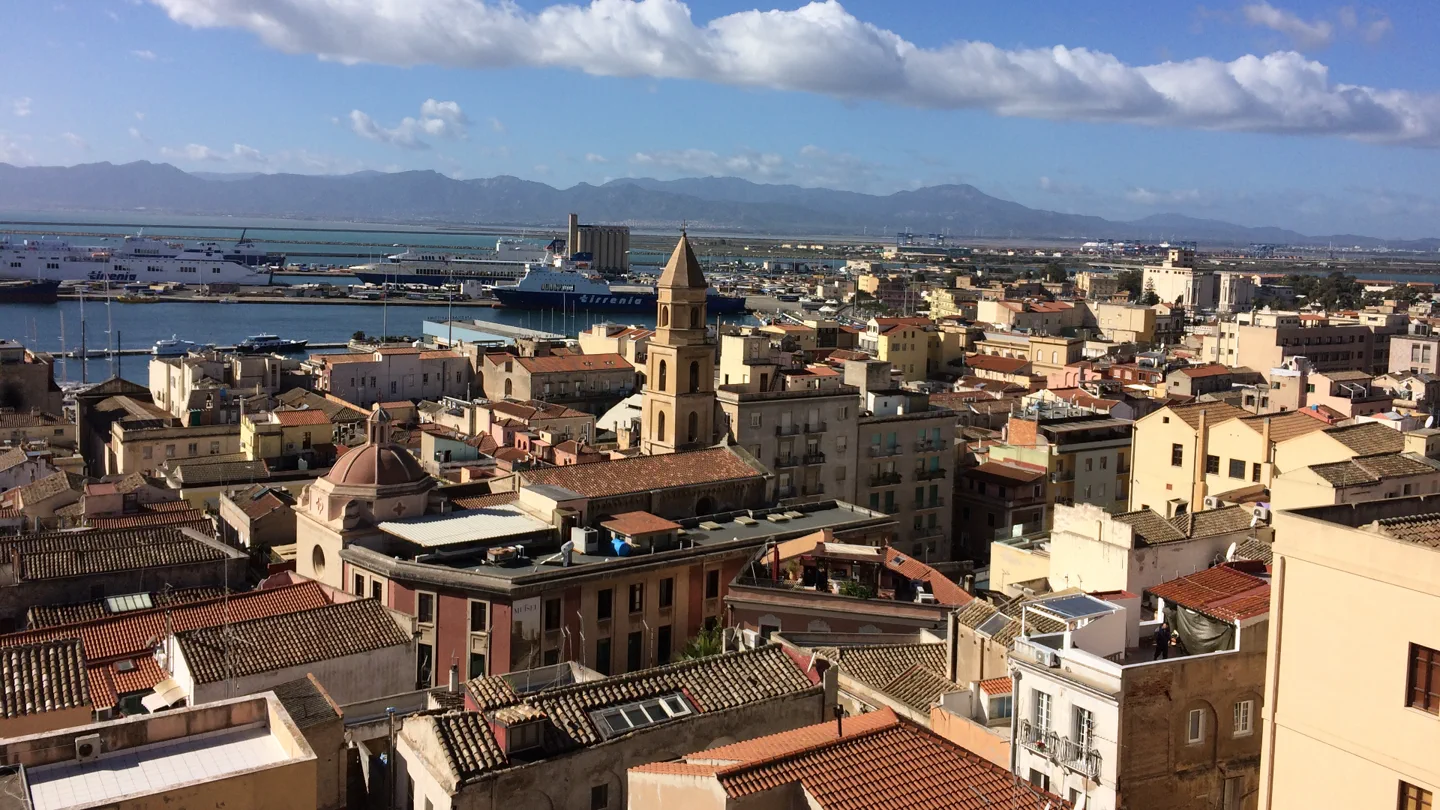
Between the walls of Castello and the harbour, the Marina is the historic district that most directly tells the story of Cagliari’s relationship with the sea. Its boundaries are still clear: Via Roma to the south, Largo Carlo Felice to the west, Viale Regina Margherita to the east and, higher up, the fortifications of the hill. Within this perimeter, alleyways, small squares, churches, workshops and homes built in different periods intertwine.
The harbour is not merely the backdrop to the district: it determined its origins and identity. Fishermen, traders, craftspeople, sailors and cargo workers animated its streets for centuries. Today, the Marina retains this vocation for bringing people together, visible in the variety of its businesses, cuisines and communities.
Lapola, the district born beside the harbour
The origins of the Marina date back to Pisan rule. The district’s first name was Lapola, and the settlement was established to accommodate warehouses and the homes of workers connected with the harbour. It was therefore a working settlement, built where the fortified city met maritime trade.
Lapola had its own defensive system of walls and bastions. During Spanish rule, the fortifications were modernised to meet new military requirements. The district was not simply an extension of Castello: it had entrances, places of worship and functions connected with harbour life, while remaining closely linked to the hill that towered above it.
From the walls to a city open to the sea
In the second half of the nineteenth century, the Marina’s walls were demolished. The disappearance of the defences radically changed the relationship between the district and the harbour front: the fortified division gave way to a more open city, organised around new urban routes and the Via Roma promenade.
Even today, this transformation can be read by passing from the inner alleyways to the broad waterfront space. Within a few steps, the scale, light and perspective change: the enclosed streets of ancient Lapola open onto the arcaded frontage that forms one of Cagliari’s monumental entrances.
Sant’Eulalia and the city hidden beneath the Marina
The place that best reveals the district’s historical depth is Sant’Eulalia. The church, one of the oldest in the Marina, was built in the Catalan Gothic style and dedicated by the Catalans to Barcelona’s patron saint. According to Cagliari Turismo’s official itinerary, it was built in the area where Lapola’s Pisan tower and the little church of Santa Maria del Porto once stood.
The most surprising discovery took place in 1990, during the restoration of the sacristy: a sixteen-metre-deep well filled with rubble led to the start of the excavations. Beneath the church, part of the ancient city emerged, including a Roman paved road, later overlain by a medieval route, as well as the remains of a small temple, a colonnade and various rooms reused over time.
The Sant’Eulalia archaeological area covers approximately nine hundred square metres. Together with the large cistern beneath the churchyard and the remains of the nearby Church of the Holy Sepulchre, it is one of the finest examples in Sardinia of an urban archaeological area open to the public. The route allows visitors to follow almost two thousand years of change, from the Roman period to the formation of the modern district.
Churches, art and the community’s memories
The Marina safeguards a particularly rich religious heritage. Beside Sant’Eulalia stands the Mutseu, the parish Treasury Museum, with paintings, wooden sculptures, silverware, vestments and archival documents. The works and records, some dating from the sixteenth century, tell not only of devotion but also of the economic and social relationships between the confraternities and the district’s residents.
On Via Baylle stands the monumental church of Sant’Agostino, built around 1577 in Renaissance forms. The earlier building stood in the area of today’s Largo Carlo Felice, where the crypt remains. Here, according to the account given by the Municipality of Cagliari, the remains of Saint Augustine were kept between 504 and 722, having been brought from Africa by Bishop Fulgentius to protect them from the Vandals’ raids.
The church of the Holy Sepulchre, in the square of the same name, is documented with certainty from 1564, the year in which the Confraternity of the Most Holy Crucifix of Prayer and Death was founded. The interior preserves chapels, furnishings and works of art; the Chapel of the Virgin of Pity is particularly notable. A Palaeochristian baptismal font was also discovered near the sacristy.
The confraternities and solidarity in the district
The Marina’s confraternities did not perform religious duties alone. The Holy Sepulchre confraternity also had the humanitarian purpose of burying people who were alone or without means, and organised processions connected with the Passion and the Virgin of Pity. The archives preserved in the Mutseu bear witness to an active presence in the religious, economic and social life of the district.
This legacy continues in Holy Week celebrations: the Good Friday re-enactment in the Church of the Holy Sepulchre, the Stations of the Cross through the Marina’s streets and S’Incontru on Via Roma bring rituals and communities back into the district’s everyday spaces.
A Marina of workshops, languages and flavours
The ancient commercial vocation has not disappeared. The municipal tourism portal describes a district where historical and religious heritage coexists with multicultural shopping and restaurants that bring Sardinian products together with cuisines from different parts of the world. It is a significant continuity: the Marina remains a place of arrivals, exchanges and encounters, just as it was when its warehouses served the harbour.
Contemporary businesses have given numerous streets a new lease of life, but the district invites visitors to look beyond the shop windows. Doorways, votive shrines, bell towers, plaques and changes in level preserve traces of the long transformation from medieval Lapola into a multicultural urban centre.
Five curiosities to remember
- The Marina had another name: in the medieval period, the district was called Lapola and arose to serve the harbour’s activities.
- A well opened the way to the underground city: the cavity discovered in 1990 in Sant’Eulalia’s sacristy was sixteen metres deep.
- Two roads occupy the same space: in the Sant’Eulalia excavations, a medieval road lies over a Roman paved road.
- Saint Augustine’s relics passed through Cagliari: they were kept in the ancient complex between 504 and 722, before being transferred.
- Solidarity had a base in the district: the Holy Sepulchre confraternity also took care of burying people who were alone or without means.
An itinerary for getting to know the Marina
A walk can begin on Via Roma and continue towards Piazza Sant’Eulalia, visiting the church, the Mutseu and the archaeological area. From here, continue to Piazza del Santo Sepolcro, Sant’Antonio Abate on Via Manno and Sant’Agostino on Via Baylle. Returning towards the harbour, the passage from the alleyways to the Via Roma frontage makes the district’s urban evolution immediately clear.
Before entering the churches, museum and archaeological area, it is advisable to check opening times and visiting arrangements on the official websites. The Marina can also simply be discovered on foot: within its few blocks, Cagliari reveals its connection with the Mediterranean, the layers of the ancient city and its ability to welcome different cultures.
Sources consulted
- Cagliari Turismo — Marina District
- Cagliari Turismo — Visit to the Marina District
- Cagliari Turismo — Sant’Eulalia Archaeological Area
- Cagliari Turismo — Church of Sant’Eulalia
- Cagliari Turismo — Treasury Museum of Sant’Eulalia (Mutseu)
- Cagliari Turismo — Church of Sant’Agostino
- Cagliari Turismo — Church of the Holy Sepulchre
- Cagliari Turismo — Archconfraternity of Easter and Parish of Sant’Eulalia
- Image: photograph by the Municipality of Cagliari on Wikimedia Commons, CC BY-SA 3.0 IT licence, adapted crop.