At the western foot of Castello, between Piazza Yenne, Via Azuni and Viale Sant’Ignazio, Stampace preserves one of Cagliari’s most layered histories. It is one of the city’s four historic districts and brings together, within a few streets, evidence of Roman Karalis, Baroque architecture, memories of the bombings and religious traditions involving the whole of Sardinia.
Its character is best understood on foot: above ground are churches, stairways and old streets of workshops; below street level are quarries, cisterns, crypts and spaces carved into the rock. Stampace tells Cagliari’s story vertically, from the ancient underground to the domes that shape its skyline.
The medieval artisans’ quarter
According to the official Cagliari Turismo portal, Stampace arose in the 13th century west of the fortified citadel of Castello and also welcomed refugees from Santa Igia, the ancient capital of the Giudicato of Càlari. Its proximity to the walls did not prevent it from developing a distinct identity: while the seats of power were concentrated above, numerous craftspeople and artists lived and worked in the district.
Workshops were a defining feature of the district for a long time. The gradual expansion of Stampace also gave rise to several areas of modern Cagliari towards the west. The streets rising from Piazza Yenne still preserve the scale of this urban fabric: short routes, sudden slopes, intimate open spaces and buildings constructed in different periods.
Before the district: the Roman city
The area’s history began long before the Middle Ages. The so-called Villa di Tigellio documents the extent of the Roman settlement in western Cagliari. The name is intriguing but misleading: the site is not the villa certainly belonging to the poet and singer Tigellio. Excavations revealed an elegant residential area comprising three domus, established in the 1st century BC and occupied, through successive transformations, until late antiquity.
Slightly higher up is the Roman Amphitheatre, built between the 1st and 2nd centuries AD by making use of a natural valley on the slopes of Buoncammino. Much of the seating, arena and passageways was carved directly into the limestone bedrock. Its estimated capacity was around ten thousand spectators, and the different tiers of the cavea reflected the rigid social divisions of the Roman city.
The area of today’s Orto Botanico also preserves Roman cisterns and wells. Monuments, garden and contemporary district thus coexist within the same landscape, showing how far ancient Karalis extended beyond the hill of Castello.
Santa Restituta, a crypt with many lives
Among the places that best illustrate the overlapping of different periods is the crypt of Santa Restituta, in Via Sant’Efisio. The hypogeum was probably a limestone quarry in the late Punic period; it later became a place of worship and an amphora store, and, after long periods of abandonment, once again a religious space.
A painting of Saint John the Baptist dating from the 13th century remains inside. In 1614, the discovery of relics led to further works and the arrangement of the altars. During the Second World War, the cavity was used as an air-raid shelter: a function that also links the site to the most painful pages of the 1943 bombings. Archaeology, devotion and civic memory therefore meet in a single space.
Sant’Efisio and the vow that begins in Stampace
The deepest link between Stampace and the city’s identity is its connection with Sant’Efisio. The church dedicated to him stands above a cave descending approximately nine metres into the rock, traditionally believed to be the prison where the saint was confined before his martyrdom at Nora.
The festival tradition recalls the vow made by the city in 1652 during the plague. Every year, from 1 to 4 May, the statue leaves the church in Stampace, crosses Cagliari and reaches Nora, before returning to the district when the vow is fulfilled. The departure transforms the surrounding streets into the symbolic heart of a celebration bringing together communities and groups in traditional dress from across the island.
The present building is largely 18th-century: the old church was demolished in 1780 and reconstruction was completed in 1782. The altar in the chapel of Sant’Efisio, dated 1791, houses the statue carried in the procession on 1 May.
Baroque churches and Via Azuni
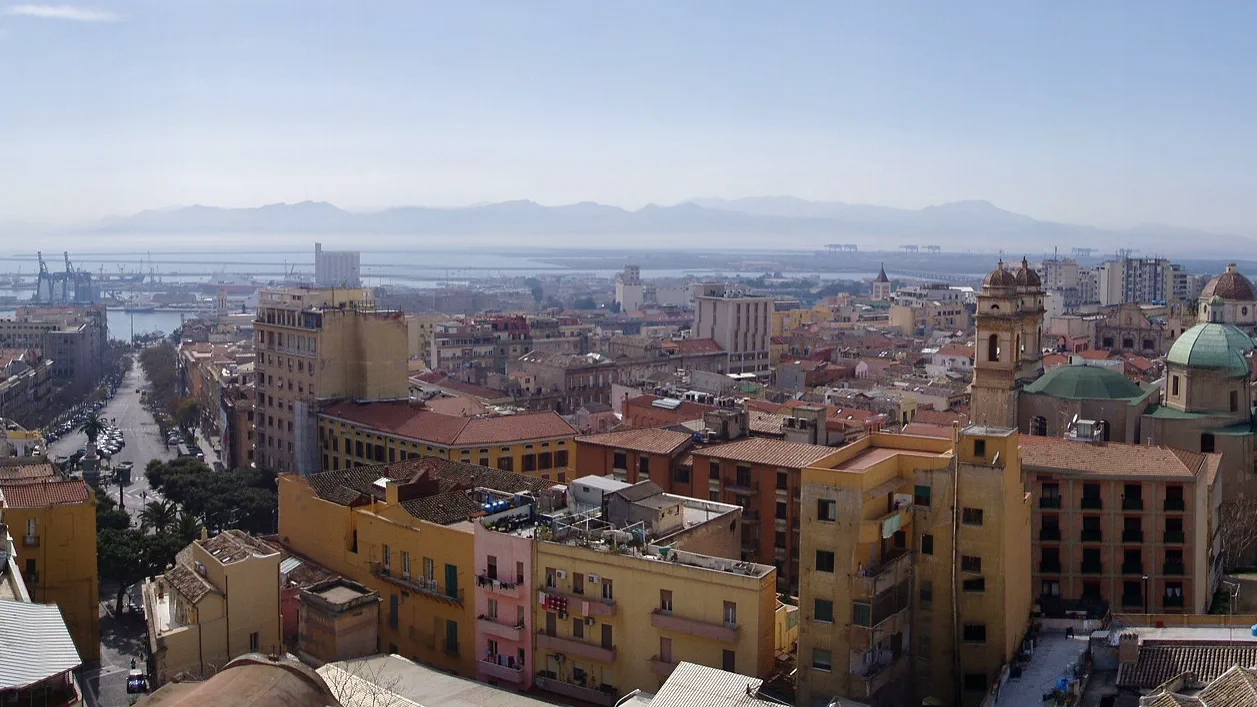
Along Via Azuni, the staircase of the Collegiate Church of Sant’Anna commands attention. The Baroque church replaced a small Pisan-era building and required around thirty-three years of work, slowed mainly by a lack of funds. Its two bell towers and three domes are now among the most recognisable features of Stampace’s skyline. The collegiate church was severely damaged by the bombings of the Second World War and was subsequently rebuilt.
Nearby, the Church of San Michele represents one of the finest expressions of Cagliari Baroque. It was built at the end of the 17th century for the Jesuits on the site of an earlier oratory. The irregular octagonal plan, polychrome marble, stucco and frescoes create an exceptionally rich interior. The sacristy also houses the wooden sculptures of the Mysteries of the Passion made by Giuseppe Antonio Lonis and carried in procession during Holy Week rites.
Palabanda: a garden above history
In Viale Sant’Ignazio stands the Botanical Garden of the University of Cagliari, opened in 1866 under the direction of Patrizio Gennari. It contains around two thousand plant species and preserves archaeological structures within its grounds. The valley was known as Palabanda and, before the garden was established, was also associated with the 1812 anti-feudal conspiracy, organised on land belonging to the lawyer Salvatore Cadeddu.
It is a detail that captures Stampace well: even a place devoted to botany contains traces of the Roman city and Sardinia’s political history.
Five curiosities to remember
- The Villa di Tigellio is not a single villa: the archaeological complex comprises three domus, and its direct connection with the Roman singer stems from a 19th-century attribution.
- A district beneath the district: quarries, cisterns, wells and crypts show how integral the limestone rock is to the city’s urban history.
- The largest festival begins on a quiet street: the pilgrimage of Sant’Efisio to Nora sets off every 1 May from the small church in the heart of Stampace.
- The amphitheatre was carved into the hill: the Romans shaped the rock to create an arena, seating and passageways for around ten thousand people.
- The domes tell the story of the district: viewed from Castello, Stampace can also be recognised by the bell towers and three domes of the Collegiate Church of Sant’Anna.
An itinerary for discovering Stampace
A walk can begin in Piazza Yenne and continue up Via Azuni towards Sant’Anna and San Michele. From here, continue to the Church of Sant’Efisio and the crypt of Santa Restituta, then on towards the Orto Botanico, the Villa di Tigellio and the Roman Amphitheatre. Before visiting, it is advisable to check opening times and access arrangements on the official websites, as these may vary due to restoration work or weather conditions.
With its archaeology, faith, craftsmanship and memory, Stampace is not merely a stop in the historic centre: it is one of the places where Cagliari most clearly reveals all its different ages.
Sources consulted
- Cagliari Turismo — Stampace District
- Cagliari Turismo — Visit to the Stampace District
- Cagliari Turismo — Villa di Tigellio
- Cagliari Turismo — Roman Amphitheatre
- Cagliari Turismo — Crypt of Santa Restituta
- Cagliari Turismo — Church of Sant’Efisio in Stampace
- Cagliari Turismo — Church of Sant’Anna
- Cagliari Turismo — Church of San Michele
- University of Cagliari — History of the Botanical Garden
- Image: photograph by Cristiano Cani on Wikimedia Commons, licensed under CC BY 2.0, adapted crop.