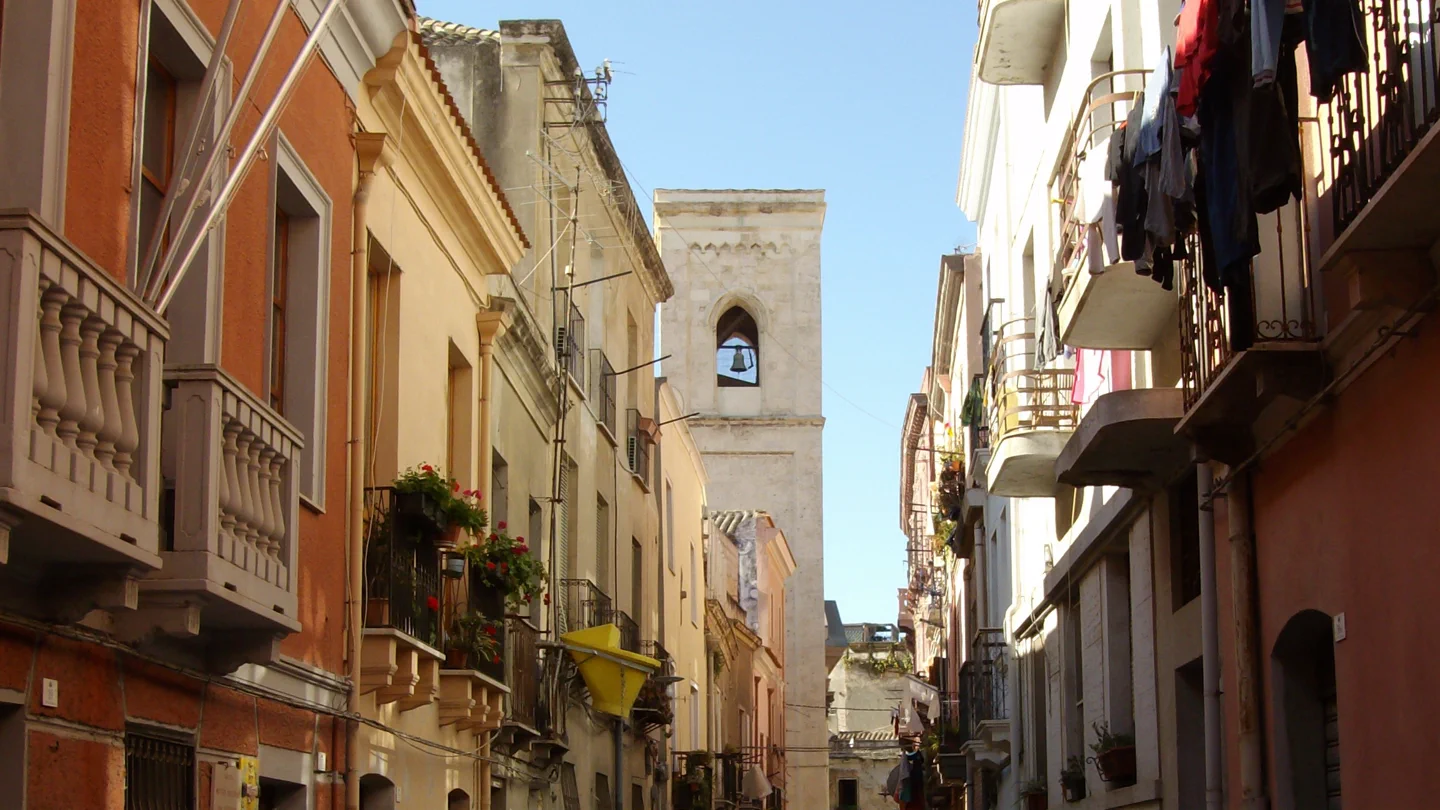
At the eastern foot of Castello, between the Terrapieno, Piazza Garibaldi and the Basilica of San Saturnino, Villanova retains a character unlike Cagliari’s other historic districts. Its narrow streets, generally lower and more modest houses, flower-filled balconies and views over the gardens reveal the origins of a village that grew outside the walls, primarily to accommodate farmers and market gardeners.
Villanova is now fully integrated into the city centre, but it remains recognisable for the compact scale of its streets and its strong sense of community. Medieval architecture, post-war reconstruction, ancient places of worship and new urban languages coexist here.
The ‘new village’ of the market gardeners
The district’s formation is documented between the second half of the 13th century and the end of that century, when the Pisans were consolidating the fortified city of Castello. According to studies by the University of Cagliari and municipal planning records, Villanova followed the model of the medieval ville nove: planned settlements outside the walls intended to organise population, activities and territory.
The eastern village welcomed workers also arriving from the Campidano, who worked in the fields, vegetable gardens and vineyards surrounding Cagliari. This agricultural vocation explains the connection still evoked today by plants and flowers outside homes. Unlike the district of power on the hill, Villanova therefore arose as a place of everyday work and of the production that supplied the city.
Via San Giovanni, the medieval backbone
The oldest layout developed around Via San Giovanni, the main axis running from north to south between the village’s ancient entrances. Via San Domenico, Via San Giacomo and Via Piccioni ran parallel to it, while transverse routes linked the homes with the cultivated land to the east.
This structure still helps us read Villanova: long parallel routes, narrow blocks and terraced houses guide walkers without the need for large monumental squares. The modern city has expanded all around it, but the fabric of the medieval district remains perceptible in the sequence of its streets.
San Giacomo, the heart of the district
The Church of San Giacomo is one of Villanova’s main landmarks. Its construction probably dates from the mid-14th century, and the building preserves evidence of Catalan Gothic architecture, despite the numerous alterations carried out between the 18th and 19th centuries. The Neoclassical façade was designed by Cagliari architect Gaetano Cima.
The church and the square in front of it are linked to the religious and social life of the district. Confraternities based in the nearby streets safeguard rites, statues and traditions that bring the community together well beyond the days of the celebrations.
San Domenico: the lost church and the one reborn
The San Domenico complex encompasses two superimposed eras. The medieval church, one of the most important examples of Catalan Gothic architecture in Sardinia, was almost completely destroyed by the bombings of 1943. The new building was constructed between 1952 and 1954 to designs by architect Raffaello Fagnoni, in a contemporary style with a limestone-clad façade.
However, the ancient layout survives beneath the modern church, now known as the Crypt of San Domenico. Bays with stellar rib vaults, side chapels and parts of the presbytery can still be made out; the Chapel of Our Lady of the Rosary survived the destruction. Descending into the crypt means physically entering the medieval Villanova preserved beneath the district rebuilt after the war.
San Saturnino, older than the district itself
In the southern sector stands the Basilica of San Saturnino, one of Sardinia’s most important early Christian monuments and the city’s oldest church dedicated to Cagliari’s patron saint. The complex arose in a burial area associated with the memory of the martyr Saturnino, killed in 304 during the persecutions of Diocletian.
An initial building was constructed between the 4th and 5th centuries and rebuilt in Byzantine forms in the 6th century. The basilica subsequently experienced donations, restoration, spoliation and war damage. Its presence is a reminder that the sacred landscape east of Castello existed many centuries before the birth of the medieval village of Villanova.
Holy Week and the confraternities
Devotion is an essential part of Villanova’s identity. During Holy Week, processions organised by the Archconfraternity of Solitude and the Archconfraternity of the Most Holy Crucifix pass through the district’s streets and reach other churches in the historic centre. For several days, statues, chants and ceremonial clothing transform the urban space into a shared route.
This is not merely a spectacle to observe: for centuries, the confraternities have helped build the community and have left their mark on its places, family memories and calendar.
From the former abattoir to a city of culture
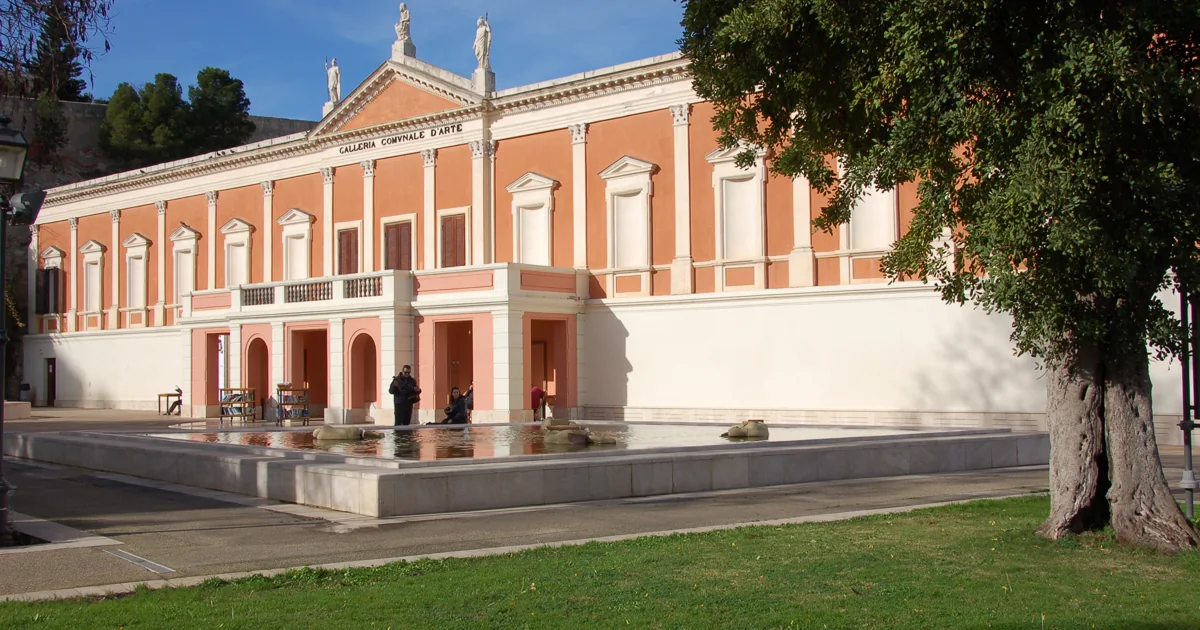
Cagliari’s expansion eastwards gradually changed Villanova’s outskirts. A significant example is EXMA: established as an abattoir when the area was still peripheral, it remained in operation until 1964 and was then used as a municipal depot. Following its restoration, it opened in 1993 as a centre dedicated to art and culture.
The transformation of the former abattoir encapsulates the shift from agricultural outskirts to central district. Nearby, the short Via San Saturnino has become an open-air art gallery, with walls decorated by writers and local artists. Tradition and contemporary creativity do not erase history: they add new layers to the urban story.
Five curiosities to remember
- A district created for those who cultivated the city: farmers and market gardeners worked in the fields, vegetable gardens and vineyards east of the walls.
- One street reveals the medieval plan: Via San Giovanni was the village’s main axis and still makes its elongated layout easy to understand.
- A church beneath the church: the Crypt of San Domenico preserves what remains of the medieval building destroyed in 1943.
- The oldest monument predates Villanova: the origins of the Basilica of San Saturnino date back to late antiquity, many centuries before the district.
- From work to culture: the former municipal abattoir is now EXMA, while Via San Saturnino hosts an open-air street-art gallery.
An itinerary for getting to know Villanova
A walk can begin at the Basilica of San Saturnino, continue towards EXMA and climb up to Piazza San Giacomo. From here, enter the district’s more intimate streets, reaching San Domenico, Via San Giovanni and the open-air gallery on Via San Saturnino, beneath the Terrapieno. Before visiting churches, the crypt and cultural spaces, it is advisable to check opening hours and access arrangements on the official websites.
Villanova invites visitors to notice the details: a plant outside a doorway, a simple façade, an arch that survived the war, a work painted on a wall. It is in this continuity between gardens, devotion and everyday life that the village preserves its most authentic identity.
Sources consulted
- Cagliari Turismo — Villanova district
- Cagliari Turismo — Visit to the Villanova district
- University of Cagliari — Villanova: city and community compared
- Cagliari Turismo — Church of San Giacomo
- Cagliari Turismo — Church of San Domenico
- Cagliari Turismo — Crypt of San Domenico
- National Museums of Cagliari — Basilica of San Saturnino
- Cagliari Turismo — EXMA
- Cagliari Turismo — Open-air gallery on Via San Saturnino
- Image: photograph by Giova81 on Wikimedia Commons, licensed under CC BY-SA 3.0, adapted crop.